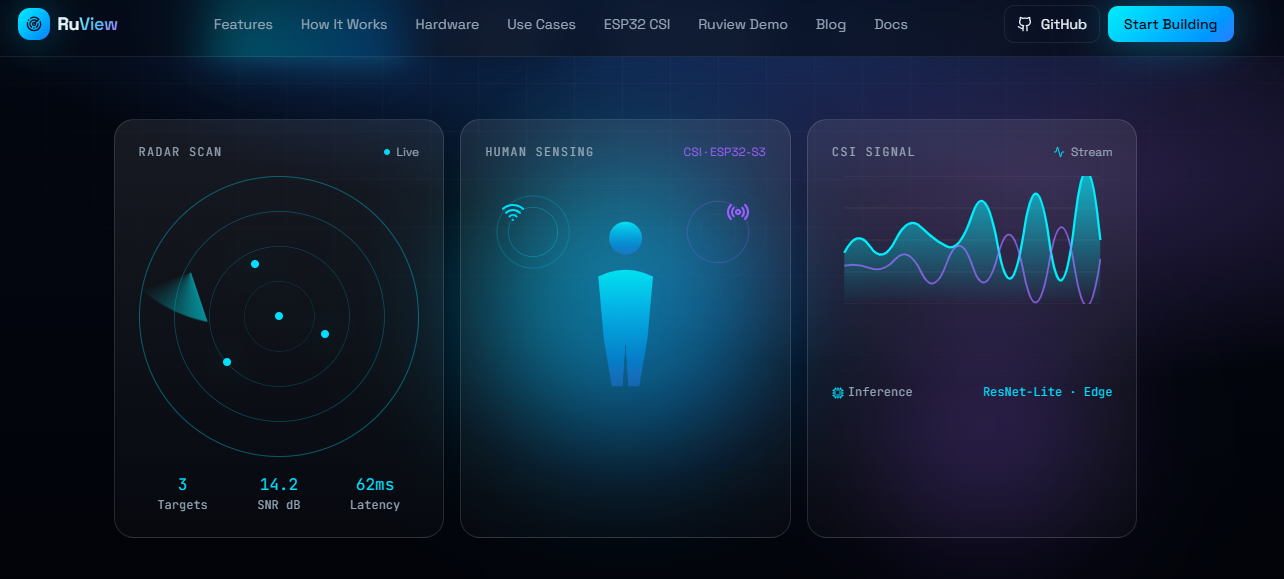
Motion detection technology has evolved significantly over the past decade. Traditional motion sensors have long been used in homes, offices, warehouses, and security systems. However, new technologies such as WiFi sensing are introducing alternative ways to detect human presence and movement.
One of the most talked-about projects in this space is RuView, an open-source WiFi sensing platform that explores human detection using wireless signals instead of cameras or conventional motion sensors.
In this article, we’ll compare RuView, WiFi sensing technology, and traditional motion sensors to understand their strengths, weaknesses, and ideal use cases.
What Are Traditional Motion Sensors?
Traditional motion sensors detect movement using physical sensing technologies.
Common examples include:
- PIR (Passive Infrared) Sensors
- Ultrasonic Sensors
- Microwave Motion Sensors
- Camera-Based Detection Systems
These devices are widely used because they are affordable, easy to install, and reliable for basic motion detection.
However, they also have limitations.
What Is RuView?
RuView is a WiFi sensing project that uses wireless signal analysis to detect human presence and movement.
Instead of relying on heat signatures or cameras, RuView analyzes WiFi signal disturbances caused by people moving inside a space.
Using technologies such as:
- WiFi CSI (Channel State Information)
- Signal Processing
- AI Algorithms
- ESP32 Hardware
RuView demonstrates how ordinary WiFi signals can become powerful sensing tools.
Many developers first discover the technology through a RuView Demo or RuView Online Demo, where signal changes are visualized in real time.
How Traditional Motion Sensors Work
PIR sensors detect infrared radiation emitted by the human body.
When a person moves across the sensor’s field of view, the sensor detects a change in heat patterns and triggers an alert.
Advantages:
- Low cost
- Easy installation
- Low power consumption
Disadvantages:
- Requires movement
- Limited detection angles
- Cannot easily detect stationary occupants
How RuView Detects Human Presence
Unlike PIR sensors, RuView WiFi Sensing uses wireless signal behavior.
The process works like this:
- WiFi signals travel through a room.
- Human bodies interact with the signals.
- Movement changes signal patterns.
- CSI data captures those changes.
- AI models analyze the data.
- Human presence is detected.
This allows RuView Human Detection systems to potentially identify activity without relying on heat sensors.
RuView vs PIR Sensors
Detection Method
PIR Sensors:
Detect heat and infrared changes.
RuView:
Detects changes in WiFi signal propagation.
Privacy
PIR Sensors:
Privacy-friendly.
RuView:
Also privacy-friendly because no visual images are captured.
Coverage
PIR Sensors:
Limited field of view.
RuView:
Can analyze signal changes across larger indoor spaces.
Occupancy Detection
PIR Sensors:
Often struggle when someone remains still.
RuView:
Can potentially detect subtle body movements and occupancy patterns.
Winner:
RuView has advantages for occupancy sensing.
RuView vs Security Cameras
Security cameras remain one of the most common monitoring technologies.
However, cameras raise privacy concerns because they capture visual footage.
Cameras
Advantages:
- Visual evidence
- High accuracy
- Object recognition
Disadvantages:
- Privacy concerns
- High storage requirements
- Installation complexity
RuView
Advantages:
- No video recording
- Privacy-friendly
- Wireless sensing
Disadvantages:
- Does not provide visual images
- Still an emerging technology
Winner:
Depends on the use case.
For privacy-focused applications, many users prefer technologies demonstrated by RuView Online Demo systems.
RuView vs mmWave Radar
mmWave radar is another emerging sensing technology.
mmWave Radar
Advantages:
- High precision
- Excellent occupancy detection
- Commercial availability
Disadvantages:
- Higher hardware costs
RuView
Advantages:
- Uses existing WiFi infrastructure
- Lower hardware costs
- Open-source ecosystem
Disadvantages:
- More dependent on signal quality
Winner:
mmWave may provide higher accuracy, while RuView offers affordability and flexibility.
Advantages of RuView
Camera-Free Detection
RuView does not require cameras.
Uses Existing WiFi Networks
Many buildings already contain WiFi infrastructure.
Open Source
Developers can experiment and modify the technology.
ESP32 Support
Affordable ESP32 boards make experimentation accessible.
AI-Powered Analysis
Machine learning improves detection capabilities.
Privacy-Friendly Monitoring
No facial recognition or video recording.
Real-World Applications
Potential use cases for RuView AI include:
Smart Homes
Automatically detect room occupancy.
Elderly Care
Monitor movement patterns without cameras.
Office Automation
Track occupancy and room utilization.
Research Projects
Study WiFi sensing and wireless signal processing.
Educational Projects
Learn about AI, ESP32 CSI, and wireless sensing technologies.
Why Developers Are Interested in RuView
Searches for:
- RuView
- RuView Demo
- RuView Online Demo
- RuView GitHub
- RuView Human Detection
have increased because developers are looking for alternatives to traditional sensing methods.
RuView combines several fast-growing fields:
- Artificial Intelligence
- Wireless Communication
- IoT
- Edge Computing
- Signal Processing
This makes it one of the most interesting experimental projects in the WiFi sensing space.
The Future of Motion Detection
Future motion detection systems may combine multiple technologies:
- WiFi sensing
- AI processing
- mmWave radar
- Smart home automation
- Edge computing
Projects like RuView demonstrate how existing wireless infrastructure can potentially become part of next-generation sensing systems.
Conclusion
Traditional motion sensors remain effective and widely used, but new technologies such as RuView WiFi Sensing are expanding what is possible.
By analyzing wireless signal changes instead of relying on heat or cameras, RuView offers a unique approach to human detection and occupancy monitoring.
While WiFi sensing is still evolving, projects such as RuView Demo showcase the exciting future of privacy-friendly, AI-powered detection systems.
For developers, researchers, and technology enthusiasts, RuView represents one of the most interesting open-source projects exploring the future of wireless sensing.
FAQs
What is RuView?
RuView is an open-source WiFi sensing project focused on human detection, motion tracking, and AI-powered wireless sensing.
What is RuView Demo?
A RuView Demo shows how WiFi signal analysis can detect movement and human presence.
Is RuView better than PIR sensors?
For simple motion detection, PIR sensors remain effective. For advanced occupancy sensing and research applications, RuView offers additional possibilities.
Does RuView use cameras?
No. RuView focuses on camera-free sensing using WiFi signals.
Can RuView detect people?
RuView is designed to analyze WiFi signal changes caused by human presence and movement.